Getting a good night’s rest is about more than just the number of hours you spend in bed; it’s about the quality of that time. If you find yourself waking up groggy or hitting a “wall” in the afternoon, your sleep hygiene might need an upgrade. These five science-backed better sleep methods can help close that gap.
Common Questions About Improving Sleep Quality
u003cstrongu003eQ: What is the 10-3-2-1-0 rule for better sleep?u003c/strongu003e
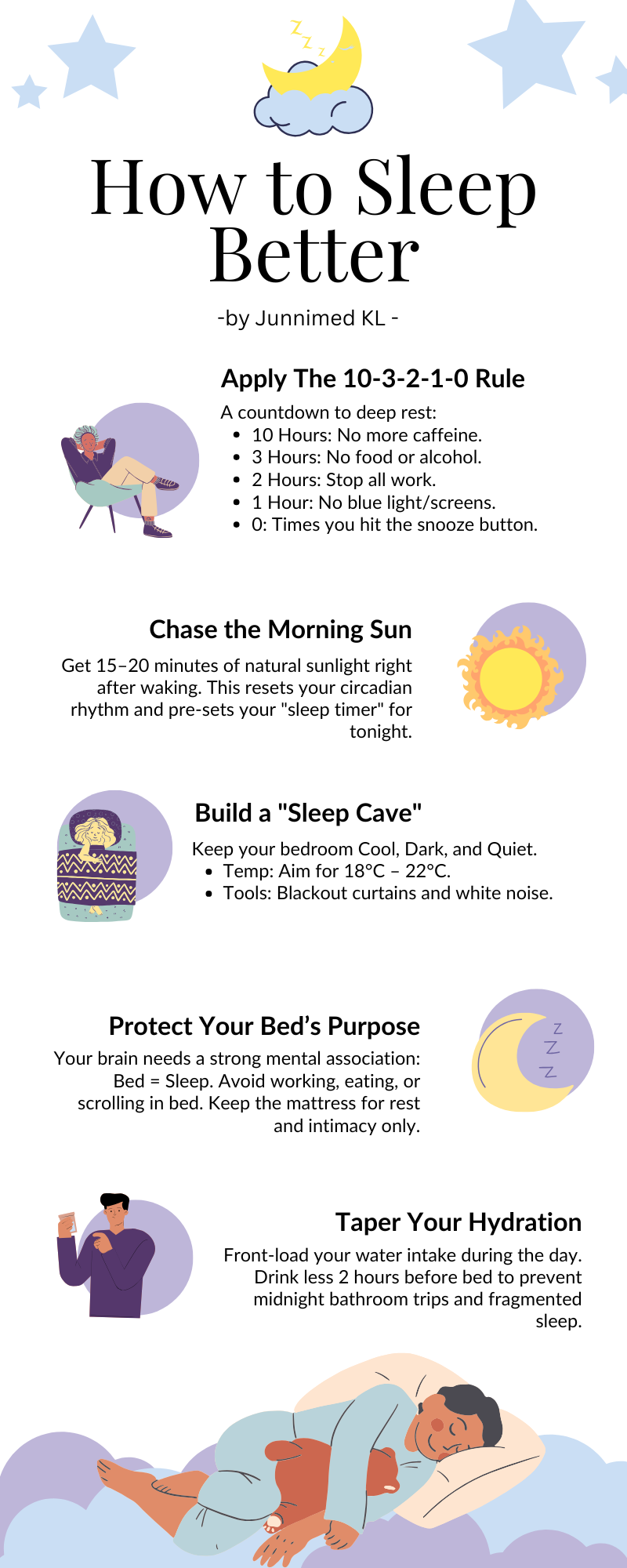
u003cstrongu003eA:u003c/strongu003e It is a systematic countdown to wind down your body: u003cstrongu003e10u003c/strongu003e hours before bed (no caffeine), u003cstrongu003e3u003c/strongu003e hours (no food or alcohol), u003cstrongu003e2u003c/strongu003e hours (no more work), u003cstrongu003e1u003c/strongu003e hour (no blue light or screens), and u003cstrongu003e0u003c/strongu003e (the times you hit the snooze button).
u003cstrongu003eQ: How does morning sunlight help me sleep better at night?u003c/strongu003e
u003cstrongu003eA:u003c/strongu003e Your circadian rhythm is light-regulated. Getting 15–20 minutes of sun in the morning stops melatonin production and triggers a u0022timeru0022 for its release 14–16 hours later, making it easier to fall asleep at the right time.
u003cstrongu003eQ: What is the best temperature and environment for sleep?u003c/strongu003e
u003cstrongu003eA:u003c/strongu003e We recommend a u0022cave-likeu0022 environment: cool (u003cstrongu003e18°C to 22°Cu003c/strongu003e), dark, and quiet. Blackout curtains and white noise machines are excellent tools to maintain this environment in noisy urban areas like KL or PJ.
u003cstrongu003eQ: Why should I avoid working or eating in bed?u003c/strongu003e
u003cstrongu003eA:u003c/strongu003e Your brain is a master of association. If you work or scroll through social media in bed, your brain associates the bedroom with u0022activity.u0022 Keeping the bed strictly for sleep helps your brain u0022shut downu0022 as soon as your head hits the pillow.
Q: I follow all these habits but I’m still tired. What should I do?
u003cstrongu003eA:u003c/strongu003e Good habits can’t fix an underlying medical issue like u003cstrongu003eObstructive Sleep Apnea (OSA)u003c/strongu003e. If you still suffer from snoring or morning headaches, it’s time for a professional u003cstrongu003eHome Sleep Studyu003c/strongu003e. At u003cstrongu003eJunnimed KLu003c/strongu003e, we can help diagnose the root cause and provide the latest Philips CPAP solutions to reclaim your energy.
When “Good Habits” Aren’t Enough
Sometimes, you can follow every sleep tip perfectly and still wake up feeling exhausted. If you experience loud snoring, morning headaches, or find yourself gasping for air at night, these lifestyle changes might only be masking a deeper issue: Obstructive Sleep Apnea (OSA).
At Junnimed KL, we specialize in helping you bridge the gap between “tired” and “transformed.” Whether you need a professional home sleep analysis to see what’s really happening while you sleep, or you’ve already been diagnosed and need the latest Philips CPAP technology, our team is here to support you. Don’t let a medical condition rob you of your energy – contact Junnimed KL today to book a consultation or visit our Shopee Store to explore our trusted sleep solutions.
Related Reading
Keep exploring: browse more Sleep Health & Lifestyle articles, or check our FAQ page for common questions about CPAP therapy.
